Sunday, 23 November 2014

Page Progress

Progress on my wall
Over the last ten days I have been working a lot with screen printing. I have been following my plan to work with the newspaper pages which I collected.

The layered pieces are already looking extremely interesting, and its great to see some stories being lost under other stories and some images and words coming through strongly. As well as sticking to my plan which was creating coloured and monochrome pieces as well as layered and individual pieces, I have decided to create one large scale image. This image has several of the prints on it in different colours and I hope to work into them with drawing and projection after I have finished with all the prints.


Close up image of layered newspaper traces
Layered newspaper traces
Through using screen-printing as my method of production I have ended up with lots of spare photocopies on tracing paper of the newspaper pages. These spare pieces have worked to my advantage as much like the prints they layer together really well and create great images. Looking at them in more detail made me think about simple experimental processes I could explore on the side while continuing to work with printing. I have used several of the copies and started tracing them in to my own image, and I plan on using a light box to help me create more hand drawn pictures. I also think that these tracing paper copies could be bound together and put towards the series of books I'll be making with my finished products.

One of the key aspects of my project is looking at the way in which physical and virtual things meet. The newspaper pages I have collected are very physical things yet you can read the same articles and news online. The news websites are constantly changing and being updated this is similar to the way in which the newspapers are developed every day. One choses which articles they would like to read and they follow them, some stories are repeatedly published and updated over a few months and some stories appear for one day and are never thought of again.
By taking photographs of the newspapers they return to the virtual world.

An internet news page allows you to follow single stories much like a paper does and eventually it alters itself for you. Internet pages like YouTube alter themselves to suggest things that you would like to see. They register what you have watched, read or looked up and find similar things for you too look at. The personal aspect of these websites relates back to the diary theme of my project, as I started this project with a personal investigation. 


Monday, 10 November 2014

My little book

The booklet presented in my sketchbook
To present my completed pieces I plan on using a book format. I think using a book format is highly relevant as it relates to the autobiographical diary theme I am going for throughout my project. I think that the way in which a book flows and changes relates to my project.

I have experimented by creating a tiny book made up of telegraph magazine covers that I have taken from a piece made shown in the Telegraph magazine to celebrate their 50th anniversary.  The covers are in order of date and gradually show the change in style and format that the magazine has gone for. The covers also demonstrate a sense of time, as they reveal cover stories which were at one point in time highly significant.


Development plan for Screens

So recently I've been trying to gather my thoughts and work towards some experimental and finished pieces. Over the last few weeks I have been collecting newspaper front pages and magazine covers. By collecting these documents I am gathering used and unwanted objects that for one day were of great significance.

I have just done two black and white drawings of the collage I created which I think have come out looking really interesting. I used charcoal, ink and pencil to create these pieces.
Jasper Johns, (layering with numbers)

Plan:
I want to continue to work with the screen-printing process. Over the next few weeks, I will be printing a screen every two days or so with the cover of a newspaper. I will do two pieces of work each time. One will be a piece with layered prints, I will print the newspapers from each day on top of each other until they create a complete piece and one will be the single cover print. I think it will be very interesting to watch the pieces develop. As I go along with this process I will document my work with photographs.
During this process I will experiment with colours, I will be using a monochrome colour scheme for some of the works and a bright and bold colour scheme for other pieces. I want to use bold attention grabbing colour for some of the work to see how the different articles will come through in the whole piece.

Jasper Johns, (American flag series)
At the moment I am looking at the artist Jasper Johns, Jasper works with layering and series. I am really interested in the way in which he develops his work and how his pieces transform. A lot of his pieces have autobiographical references. For example his work with the American flag. He uses a variety of colours and techniques to create his pieces. Johns' uses 'Things the mind already knows' as inspiration for some of his famous pieces of art. He uses what is around us and what people would recognise to create pieces and then edits and changes them in to interesting pieces.

Monday, 3 November 2014

Return from New York

I just returned from New York city and I had the most amazing time. The art galleries there are amazing and over the six days I was there I decided to go too three.

New York is an amazing city and the city itself is a piece of art. The buildings such as a the Seagram building and the Chrysler building are mesmerising and while I was there I couldn't stop myself from constantly stopping in the street to take in the beautiful surroundings.

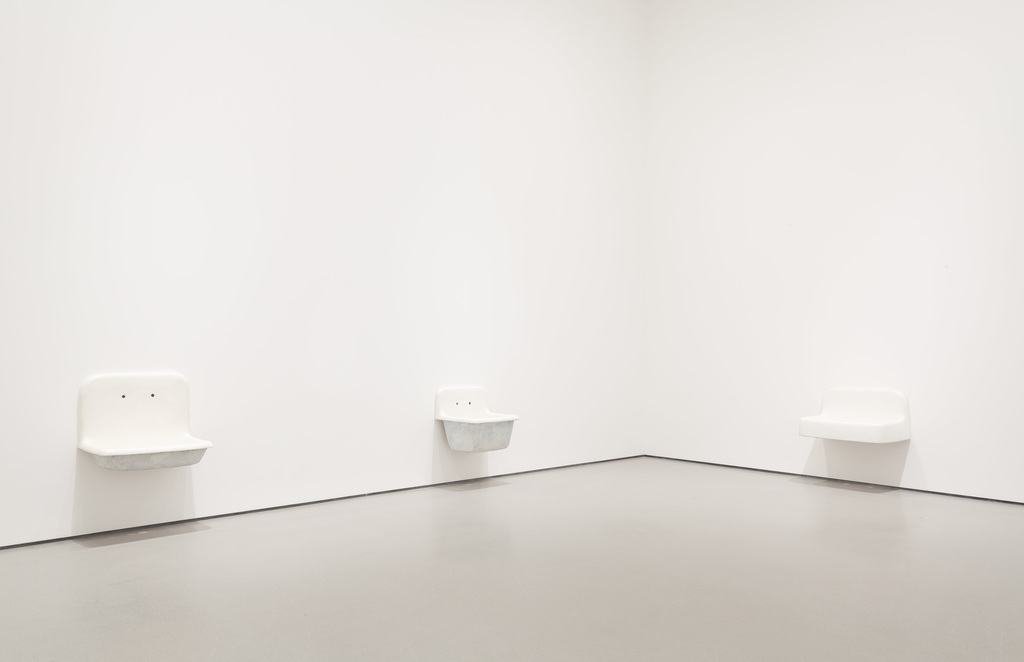
The first gallery I visited was the MOMA (museum of modern art). The MOMA has an amazing collection of art and it was a privilege to view so many famous and amazing pieces of art. The artist that stood out the most for me was an artist called Robert Gober. Gober's exhibition was called 'The Heart is not a metaphor'.  This exhibition is the first large scale survey of Gober's career to take place in the United States. In Gober's early career he created deceptively simple sculptures of everyday objects. One of his most interesting sculpture compositions was created by sinks. Gober removed the taps of the sinks and attached them to the walls, this acted as a metaphor for the useless action of washing hands whilst there was an aids epidemic. His art deals with political and social issues which are fascinating.  In the 1990's his practice evolved from single works to theatrical room-sized environments. The exhibition of work I views was a loosely chronological presentation which traces his body of work. The work highlights themes and motifs that emerged in the early 1980's.

Audience 1 Florence, 2004 by Thomas StruthI also visited the MET (metropolitan museum of art) while I was in New York. The MET itself is a piece of beautiful architecture, and the roof garden installation on part of the roof of the building reveals some of the best views across the city and central park.  The MET is filled with an almost overwhelming amount of art and artefacts. I took strong interest in a photographer named Thomas Struth. Struth is a German photographer who is best known for his family portraits. In the collection of Struth's work a variety I of his different pieces were shown. The collection of pieces explores the traditions and actual conditions of our world on the cusp of this newly global millennium. Struth's photographs deal with the truth and the relationship between mankind and machinery. Some of Struth's pictures are made in museums, he deliberately puts photography in a relationship with traditional art as he sets up a formal correspondence between them both. This is done by photographing the people who have come to view art. The picture displayed to your left is a photograph taken of a group of people looking at the sculpture Michelangelo's David. In this photograph we do not see the Renaissance masterpiece. Instead, Struth has chosen to focus his attention on the people gathered before the sculpture, an everyday and ordinary realm that typifies a predominant interest for photographers.

At the MOMA I picked up a book on all the art that had been displayed there over the last few years including information about the artist. I am hoping as I read this I will come across artists which will help me progress with my project.


Henry Clay Frick.jpg
Henry Frick
The last collection I saw in New York was the Frick Collection. The Frick Gallery is in Henry Clay Frick's house in the upper east side of the city and it houses arguably one the most amazing private collections of art in the world, it holds the biggest collection of European art in the United States. Frick was an industrialist and a business man and with his earnings he decided to collect art. His house in Manhattan complete with the all the furnishings, ornaments and paintings was opened to the public as an art museum years after he died. The amount of art in this house astounded me and it was a pleasure to be able to visit the building. The collection houses several very large paintings by Turner and Constable and houses art ranging from the pre-renaissance to the post-impressionist era. I found the atrium in the middle of the house that housed a beautiful water feature and indoor garden the most amazing aspect of the building. Frick had designed the building himself and had aimed for a neo-classical appearance.


My time in New York was amazing and I loved soaking up the culture for the six days that I was there.

The Screen Printing Process

Throughout my art projects over the last few years I have experimented with screen-printing. I thought I would explain the process of screen printing for you to understand.

Screen printing is a printing process that uses a woven mesh screen to support an ink-blocking stencil to receive a desired image. 
Using an image with strong contrasts you use a light box and the stencil shape copies onto the screen. Using printing ink you make the colour you want and place it on the downside of the screen.
Using a blade push the paint across the screen, then put the material you wish the image to be printed on below and pull the blade back across the screen. 
Use a thick layer of ink when doing your prints, and make sure you thoroughly wash your screen after using it.

Below is an image of the process:


Dieter Roth


Dieter Roth


Dieter Roth is a really interesting artist to study and he helped me start my project and get some ideas.
Roth is a German-Swiss artist who lived between 1920 and 1998. Throughout his career his work varied massively but he worked with obsessive energy and used sculpture/installations/assemblages and books to create interesting and unique pieces of art. Much of Roth's art revolves around the theme of recordings and diaries. He likes his art to reflect his life and he works with his own possessions to create his pieces. Many of his exhibitions act as interesting insights into his personal life. His diaries served as a variety of different things. Within his diaries he had 'to do' lists and agendas. His ideas and thoughts were scribbled down and he revisited what he had written many times. Roth acted as an artists who wrote down any idea he had and he wrote it down on whatever was available to him. In one of his exhibitions some Tablemats are displayed where we can see he has written down his urgent thoughts and ideas. Roth worked with collections of items. He liked to archive various things from his life, such as unwanted items and discarded things. He collected receipts, wrappers and magazine pages. All his art was concerned with a theme of autobiographical analysis.

One of the most interesting things Roth did was filming himself. In his late life Roth was close to death as he was a heavy drinker and had a poor diet, in order to monitor himself he decided to set up cameras all around his house.  The art was displayed on a group of monitors stacked on top of each other, darkness encroaches on the screen nearing the end this symbolises the death of Roth making the piece of art extremely poignant. Whilst Roth was ill he lost a huge amount of weight making his old clothes unwearable, he created an art piece with his old clothes. The clothes appear in a piece called 'Clothes Picture' . The clothes act as a piece of self portraiture.

Throughout Roth's life he created many incredibly interesting pieces. The way in which he used diaries to create art is what initially drew me to look at him as an artist in greater depth. Although much of his work is interesting to look at I decided to focus on the way in which he reworked his diaries and studied them and made art using them. This is something I experimented with as time went on.

Saturday, 1 November 2014

Hello! Time to Catch Up


Hello,


Art Wall
This is my first entry to my blog and its a little late. I am starting this blog about half way through my coursework project for my A level Art. The purpose of this blog is to keep an up to date account of what I am doing in my project. It is going to be a place where I can organise and store my thoughts and progress. I am also accounting my work in three other ways, during the project I will be keeping a formal sketchbook for my idea and work at A2 scale, and an exhibition/artist sketchbook where I will account the exhibitions I have been to and which artists I have taken interest in at A5 scale. I have also been given a wall to stick thoughts images and work up on as a visual aid for my ideas, this will be constantly changing as it will be somewhere for me to place my ideas.
I started my project with a personal investigation. As I am someone who finds value in sentimental memoirs such as letters and photographs I decided to look at my diaries from the last four years for inspiration. Each diary differs in its own way and as a collective they show progression in personality and a sense of maturing. The diaries made me think about mark making and writing down thoughts, at each moment the things written in these diaries were of some significance yet looking at them now I can hardly remember why I wrote them. The diaries lead me to look at the artist Dieter Roth, an artist who works with collected items. I will write a single blog entry on him later on.

I had lots of ideas when I started my project and I found it hard to narrow my ideas down to one key concept so I explored different aspects of what I wanted to do.

Firstly: Firstly I looked at mark making and doodles, and how I had scribbled and drawn all over different parts of my diaries, I found the marks interesting and briefly explored the different progressions with my marks.

Secondly: Secondly I looked at the theme of time and progression and general development. How things change over time. I looked at a sequence of cover I found in the telegraph magazine which helped me explore this idea. Looking at common themes that still develop over time. Things that keep one principle idea but are always changing and progressing.

Finally: (the chosen idea) Finally I looked at the theme of layering and collectives, how each page made up one diary and how each diary made up another idea. I wanted to make something out of nothing. This is an idea that I really explored, I focussed in on the idea of making insignificant items have some significance, and changing and developing them in to whole pieces. I decided to focus on this idea and leave the other two ideas behind to come back to for inspiration or movement if I needed them in my project.

Collage
I explored my chosen idea with collage. I started by choosing sections/pages and inserts from the different diaries and layering them on top of each other and using a simple collaging technique to create a two dimensional piece. The piece came out looking really interesting. The colours that came from some of the sections had washed across the piece and some of the images became distorted, the most interesting aspect of the collage was the way in which you could see parts of pages coming through underneath other parts where I had layered them. I decided to use this collage for a screen print. I will write a blog on the screen printing process later on. The screen-prints looked really interesting and lead me to look at an artists called Robert Rauschenberg. Rauschenberg uses newspaper pages and found documents to create powerful collage pieces. The screen-printing process lead me to take off in the project. I decided I wanted to create a drawing of the collage and perhaps print onto the works. By using layering I would work back on to the pages of the diaries with the screen printed images of the diaries. Layering and collaborating different parts.

Next Steps:
  • Create a drawing of the interesting original collage including the colourful aspects of it
  • Create a new collage with stronger contrasts to make more defined screen prints
  • Continue to collect different objects and watch things progress and change
    • screenshots of Facebook newsfeed
    • newspaper covers
    • magazine covers
  • During the project working on to my wall and layering the ideas and taking photographs each time its changes to show gradual development.

P.S This will probably be my longest blog entry as I had a lot to catch up on.